
Beyond Structural Repair: Protecting Neighboring Root Systems During Multi-Unit Restorative Care
Modern multi-unit restorations demand microscopic precision to safeguard nearby natural roots. By utilizing advanced digital mapping alongside conservative margin preparation, clinicians prevent root resorption, maintain periodontal ligament health, and ensure long-term stability for complex dental reconstructions across East Akron and surrounding communities.
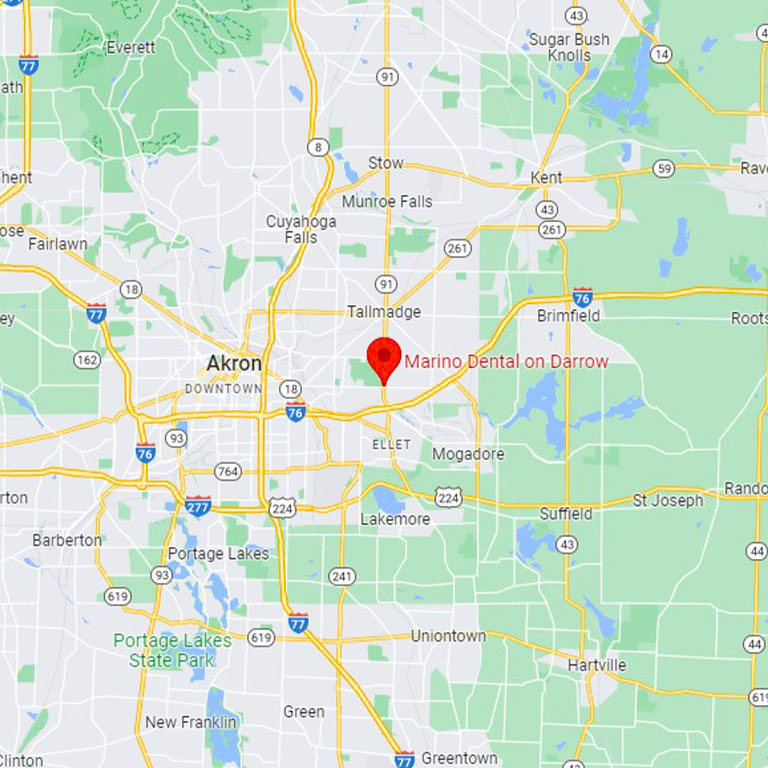
Navigating complex dental repairs requires a thoughtful balance between restoring damaged teeth and preserving surrounding natural structures. At Marino Dental on Darrow, located right off the Darrow Road corridor near Goodyear Heights Metro Park, our clinical team focuses on protecting adjacent biological assets. Patients seeking multi-unit bridges or crowns often worry about long-term root health. Advanced diagnostic tools allow our team to visualize underlying structures before making any physical alterations. We utilize CBCT 3D volumetric mapping, an advanced imaging modality that creates detailed three-dimensional renderings of bone density and nerve pathways, to measure safety zones around neighboring roots down to the millimeter.
Biological Mechanics of Adjacent Root Protection
When placing multi-tooth restorations, excessive vibration, improper margin depths, or uneven pressure distribution can inadvertently compromise neighboring healthy teeth. Preserving the delicate periodontal ligament space prevents localized inflammatory responses and thermal trauma. Careful execution during subgingival margin preparation, which involves shaping tooth structure slightly below the gumline to create seamless restorative transitions, prevents bacteria from colonizing vulnerable root dentin. Furthermore, calculating precise occlusal load distribution, which refers to how chewing forces spread across the entire dental arch, prevents micro-fractures in neighboring roots. Modern ceramic materials work in harmony with natural tooth structures, preventing artificial stresses from causing structural fatigue in adjacent natural teeth.
Comparing Restorative Approaches for Multi-Unit Root Preservation
| Restorative Technique | Impact on Adjacent Roots | Bone Density Retention | Precision Level |
| Legacy Multi-Unit Bridgework | High risk of enamel shaving on support roots | Moderate localized bone loss over time | Manual visual alignment |
| Guided CAD/CAM Biomimetic Restorations | Minimal alteration of neighboring healthy structure | High bone preservation via targeted stimulation | Sub-millimeter digital accuracy |
| Traditional Non-Guided Placements | Potential for thermal stress and root proximity conflicts | Variable depending on manual drill angles | Standard tactile estimation |
Key Clinical Protocols for Safeguard Placement
Preserving the microenvironment of adjacent natural teeth in multi-unit restorations helps ensure that overall bite strength remains stable for decades.
- Precise digital impressions eliminate mechanical trauma to adjacent soft tissues during scanning.
- Low-heat surgical handpieces protect vulnerable pulp chambers in nearby natural teeth.
- Custom biocompatible zirconia, an exceptionally strong, non-metallic ceramic compatible with living tissue, helps prevent tissue inflammation at the gumline.
- Post-operative volumetric imaging verifies that spatial clearances around neighboring root apexes remain completely uncompromised.
Common Questions About Restorative Root Preservation
Will restoring multiple teeth damage the healthy natural teeth right next to them?
Restoring adjacent teeth requires extreme care, but modern digital planning prevents unintended stress on surrounding natural structures. Our team utilizes detailed three-dimensional scans to map exact boundaries, ensuring your healthy teeth remain completely undisturbed and fully protected throughout your treatment journey.
How do digital scans protect my natural root systems better than traditional impressions?
Traditional putty impressions only capture surface outlines, whereas advanced digital scanning provides complete spatial clarity beneath the gumline. This high-definition visibility allows us to evaluate root alignment, bone thickness, and nerve locations before any procedure begins, giving you a smooth and predictable experience.
Is the recovery process uncomfortable after receiving multi-unit restorations?
Mild sensitivity is normal for a day or two, but our conservative, gentle methods minimize inflammation in surrounding tissue. You can quickly return to your routine, resting assured that your restored smile is built on a firm, healthy foundation.
Schedule Your Restorative Dentistry Consultation in Akron
Protecting your natural teeth while rebuilding your smile requires a skilled balance of high-tech accuracy and attentive care. If you live near Ellet, Tallmadge, or Goodyear Heights, visit our comfortable practice along Darrow Road for a personalized consultation. Contact Marino Dental on Darrow today to explore how our advanced digital imaging and custom restorative treatments can restore your confidence and preserve your lifelong oral health.